It isn’t easy being a misunderstood genius.
It isn’t easy being a misunderstood genius, so you can imagine how gratified I felt when I received an email the other day from someone named Francis Idris, who demonstrated a deep understanding of my thinking, and recognized the brilliance of my book, “Good News Bad News: Journalism Ethics and the Public Interest.” Westview Press, 1998.
(Nobody else recognized its brilliance at the time.
Thanks for reading! Subscribe for free to receive new posts and support my work.
“It takes a specific kind of stubbornness,” “Idris wrote, “to spend twenty years writing about restaurant menus in Minnesota while quietly worrying about the survival of democratic society…Good News, Bad News sits in that weird academic purgatory where brilliant ideas go to get buried under standard press releases…And yet the crisis Jeremy diagnosed two decades ago looks less like an academic footnote now and more like an ongoing slow-motion train wreck.”
The problem with the book, Idris explained, was that the way it was presented had kept it from reaching the audience that needed to hear its still-timely message. And he had a solution to that problem.
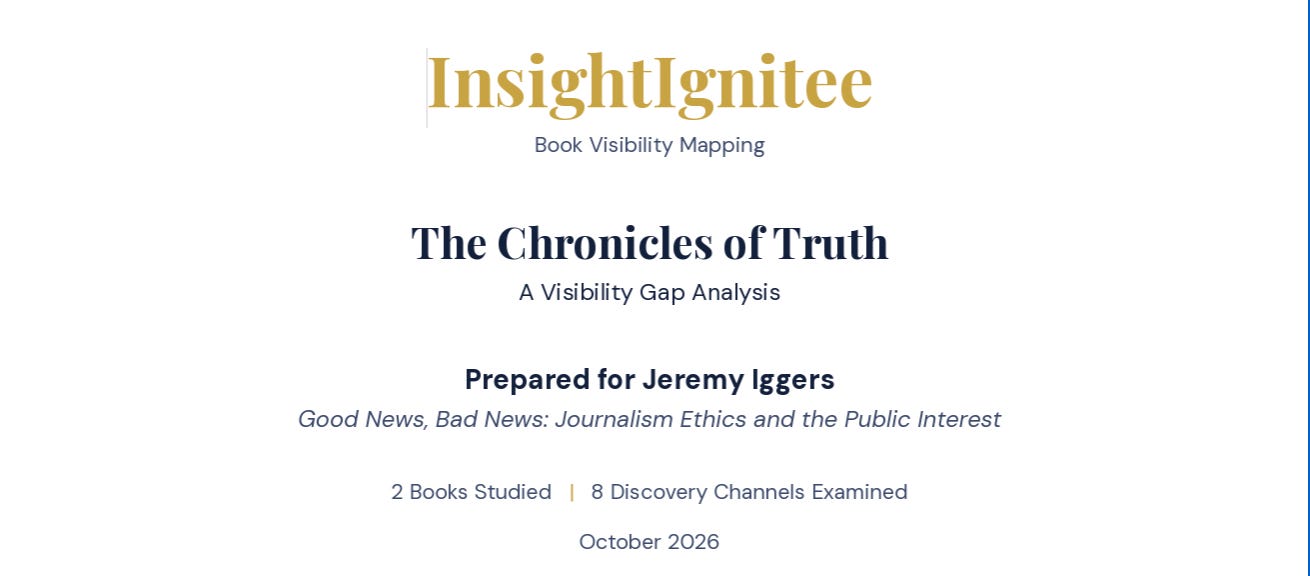
I pasted a sample paragraph from Idris’s email into Pangram, and sure enough, the AI checker estimated that it was 100% AI generated. Then I did a search for Francis Idris, and could find no evidence that he actually existed.
This isn’t my first encounter with an author scam, but this one took it to a new level. Idris – or whoever he is – followed up with a five-page proposal for visibility services, which range from $497 for the Emerald package “For the author who has never had professional visibility work done on their book,” to $4997 for the Platinum Complete Visibility Ecosystem, “For the author who wants to know that every discovery channel available has been activated for their book.”
Oh well. Like I said, it isn’t easy being a misunderstood genius.
I did it! I finally canceled my Audible subscription!
I recently launched a website that encourages people to boycott Amazon, de-Google their lives and break up with Facebook, so I figured it was time to more actively practice what I preach.
I had been intending to cancel for months, and I got as far as putting my subscription on a three-month hold a couple of times, but I had so many credits piled up that I didn’t want to cancel until I could use them up, and I never found time to select five books I really wanted to read, so the holds ended and the credits kept piling up.
It turns out that this is not unusual. In fact, Audible’s membership program is carefully designed to be as sticky as possible. A quick search turned up articles and videos with titles like “How Audible Cracked The Code On Subscriber Retention,” and “A Lesson in User Retention – Audubon’s Audible.” A couple of people confessed to having 12 unused credits, and of course, the more unused credits you have, the harder it is to say goodbye.
But this time, I finally did it, and then recorded the deed by clicking the checkbox on the Resist Twin Cities homepage.
I don’t think I am going to miss Audible. I listen to very few audiobooks these days, and when I do, I usually check them out and download them for free from the Hennepin County Library. And striking this tiny blow against Jeff Bezos’s evil empire gave me a good feeling.
I would love to hear your thoughts about this, and I would really appreciate it if you posted your comments on the original article (link in the comments). You will have to provide your name and email. but I won’t share it with anyone.